


We need to talk about the latest moral panic circulating through your feed.
You know the one. It arrives as a smug screenshot of a scientific paper, accompanied by triumphant commentary insisting that artificial intelligence literally melts your brain, atrophies your memory, and reduces your critical faculties to lukewarm oatmeal.
If you spend five minutes in progressive, leftist, or creative spaces, you have seen this narrative repeated like holy writ. It comes wrapped in righteous disdain for "techbros," heavy sighs for the lost sanctity of doing everything the hard way, and a comforting conclusion: See? The machines are making us stupid. Stay away.
There is only one problem. The science does not say that.
In fact, the cognitive researchers behind the very preprint everyone loves to wave around built an entire website specifically begging people to stop saying it.
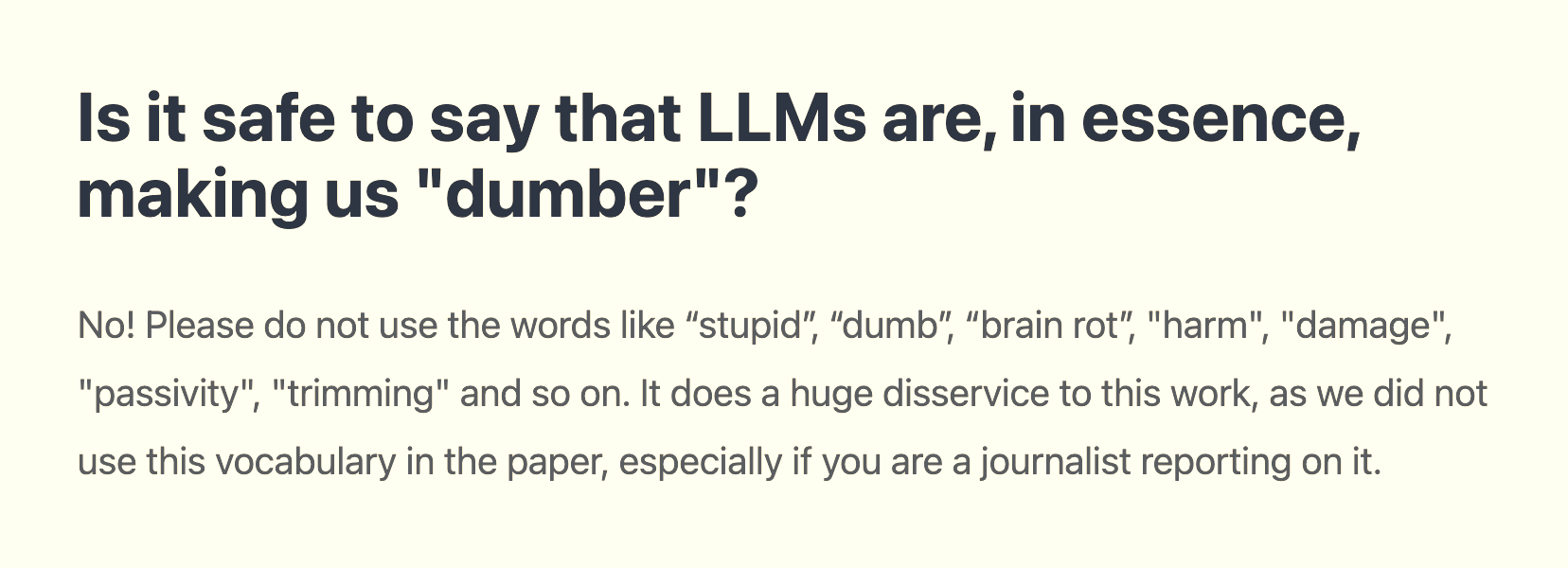
But almost nobody read the researchers' FAQ. Almost nobody looked at the methodology. And nobody on social media bothered to look at the control groups that complicate the neat little story they wanted to tell.
Instead, our corners of the internet did something deeply embarrassing: they borrowed the exact epistemological playbook of the anti-vaxxers and anti-maskers they spent years ridiculing.
Let's look at what the study actually did.
 Nataliya Kosmyna

The Receipts: What the MIT Study Measured
The paper everyone is citing is a preprint titled "Your Brain on ChatGPT: Accumulation of Cognitive Debt when Using an AI Assistant for Essay Writing Task," led by researchers Nataliya Kosmyna, Eugene Hauptmann, and Pattie Maes at the MIT Media Lab.
Let's start by giving the authors their due: their research addresses a genuine, vital question.
The researchers hooked 54 participants up to electroencephalography (EEG) caps to track electrical brain connectivity while they wrote essays across multiple sessions. The participants were split into three conditions:
- The Brain-Only Group: Wrote essays using only their own heads. No outside assistance.
- The Search Engine Group: Used traditional search engines to research and draft.
- The LLM Group: Used ChatGPT to help generate and write their essays.
The researchers found something real: when participants were placed in the LLM condition, their neural connectivity systematically scaled down. When asked to write an essay from scratch using an unconstrained conversational chatbot, they offloaded their cognitive effort. They reported significantly lower feelings of "ownership" over the final text, and they struggled to quote or accurately recall what they had just produced. Over repeated sessions, this passive reliance compounded into what the authors accurately termed cognitive debt.
If that were the end of the story, the panic-mongers would have a point. But it wasn't the end of the story.
What the Critics Deliberately Left Out
Science is defined by its controls, its caveats, and its edge conditions. That is where the nuance lives. And that is exactly what the anti-AI commentary stripped out.
First, the authors published an explicit FAQ at brainonllm.com with a direct plea to journalists and commentators. When asked if it is safe to say that LLMs are making us dumber, the authors wrote:
"No. We strongly request that people (and journalists/media reporters in particular) do not use words such as: 'stupid', 'dumb', 'brain rot', 'harm', 'damage', 'passivity', 'trimming' etc. Using these words does a huge disservice to this work, as this vocabulary was not used or implied in the paper."
They went further, explicitly urging the public to avoid phrases like "brain damage," "LLMs make you stop thinking," or "terrifying findings." They pointed out that their sample was small (54 participants across initial sessions, 18 in the crossover phase), localized to a few academic institutions, and captured an un-peer-reviewed exploratory preprint.
More importantly, the authors noted a critical methodological limitation: the writing task was administered as an undivided, all-in-one lump. It did not break the writing process down into discrete phases like brainstorming, outlining, drafting, and editing. Participants were simply told to write an essay with a chatbot, and many of them took the path of least resistance: they asked the bot to write it, skimmed the output, and called it a day.
Now look at what happened in Session 4.
In the fourth session, the researchers crossed participants over. They took the participants who had spent the first three sessions writing with their brains alone - building their own mental scaffolds, formulating their own ideas, and exercising active judgment - and gave them access to ChatGPT.
Did their brains melt? Did their critical faculties vanish?
No.
The participants who brought an active mental architecture to the tool showed high memory recall and active neural engagement in occipito-parietal and prefrontal networks. Their cognitive patterns mirrored the active, engaged search-engine group.
And this isn't just an artifact of eighteen students in an exploratory MIT lab. In a massive field experiment published in the Proceedings of the National Academy of Sciences (PNAS), researchers at the University of Pennsylvania tracked thousands of high school students using generative AI and documented the exact same split. Students given unconstrained ChatGPT treated it like an answer-dispensing crutch; when the AI was taken away, their unassisted exam scores cratered by 17% compared to peers who had never touched the tool. But students given an AI configured as a Socratic tutor - designed with guardrails that prompted reflection rather than spitting out answers - showed preserved and enhanced long-term mastery.
As Harvard computer scientists demonstrated in their landmark study on cognitive forcing functions, critical thinking doesn't evaporate simply because an algorithm is present. It evaporates when corporate interfaces are designed to be so frictionless that human beings are never required to form a hypothesis before receiving an answer.
The Leftist Anti-Vax Trap
This brings us to the uncomfortable part of the conversation.
During the height of the COVID-19 pandemic, leftists and progressives correctly diagnosed the fatal flaw in the anti-vaccine movement. Anti-vaxxers would take a preliminary, non-peer-reviewed preprint out of context, ignore the authors' explicit caveats, discard the broader body of clinical data, and blow up an alarming headline into a universal conspiracy. When an immunologist pointed out the flaws in their reading, the anti-vaxxer had an all-purpose escape hatch: "You're just a shill for Big Pharma."
Now look at how our spaces talk about AI.
People take one preliminary EEG preprint, ignore the authors pleading with them not to call it "brain rot," ignore the crossover data showing that active users maintained high cognitive engagement, and proclaim that science has proven AI makes you stupid. And when someone points out what the paper actually measured, the critic deploys their own all-purpose escape hatch: "You're just shilling for Silicon Valley techbros."
It is the exact same intellectual failure mode.
Let me be clear about this point: distrusting Silicon Valley is healthy, rational, and moral. Pfizer really is an extractive, profit-maximizing pharmaceutical giant. And Sam Altman, Microsoft, Google, and Meta really are ruthless corporate monopolies bent on enclosing digital commons, extracting worker data, busting unions, and juicing their share prices.
Hating the oligarchs who own the infrastructure is not the problem. The problem is confusing the capitalist business model with the underlying physical tool.
When you hate Pfizer, you don't respond by drinking raw milk, catching polio, and declaring immunology a hoax. That doesn't hurt Pfizer's executives; it just kills your neighbors.
And when you hate Silicon Valley, you don't respond by declaring cognitive tools evil, retreating into reactionary technophobia, and refusing to understand how these systems work. That doesn't hurt the tech oligarchs. It simply leaves the working class completely disarmed.
The Class Struggle Over Tool Ergonomics
Why did that first group of participants in the MIT study experience cognitive debt?
Because of how commercial, proprietary AI is currently designed by Silicon Valley.
Under capitalism, corporate software is not designed to expand human capability. It is designed for frictionless consumer capture. Venture capital wants you inside a slick, walled-garden interface where you type a vague prompt, receive a finished answer, and become helplessly dependent on their proprietary subscription.
More critically, corporate management wants AI designed for labor deskilling. As I explored when dissecting why capitalism lied about why you need a boss, capital has always sought to strip workers of autonomous craft knowledge. If a boss can reduce complex analytical work to pushing a single button on a cloud dashboard, the worker becomes interchangeable, disposable, and cheap.
Cognitive debt is not an inherent property of large language models. It is the deliberate design choice of corporate management.
Anarchist analysts like the CrimethInc. collective have argued for years - from their seminal essay Deserting the Digital Utopia onward - that digital infrastructure under capitalism is never neutral. It is engineered from the ground up to enclose the commons, extract unpaid cognitive labor, and render the working class dependent on corporate platforms. They are completely right about the pathology of corporate software. But where traditional anarchist critiques often settle for withdrawal or passive refusal, the material reality of labor demands a different move: contestation and worker control.
When management forces a worker to use AI as an automated speed-up machine, cognitive debt is guaranteed. But when workers exercise sovereignty over their own tooling, the dynamic flips entirely.
This is what researchers at Harvard and Boston Consulting Group found when studying 758 knowledge workers in their landmark paper on the "jagged technological frontier." Workers who blindly outsourced their thinking - what the researchers called "falling asleep at the wheel" - saw their output quality collapse. But workers who used the technology as an active collaborator, structuring their work either as "Centaurs" (a clear division of labor between human strategic synthesis and AI execution) or "Cyborgs" (tight, continuous, reflective interaction), saw their performance and creativity leap by 40%.
The difference isn't the model. The difference is who holds the reins.
Mind Over Hands: The Pro-Worker Path Forward
In my essay on why people equate toil with righteousness, I unmasked the Calvinist elect-anxiety that still infects modern labor debates. Capital has trained us to believe that physical and mechanical suffering is the only valid proof of dignity. If you didn't break your back or type out every single boilerplate syllable by hand, you must be cheating.
That is why the words on the header of this post cut so deep:
"When you create with AI, you use your mind, not your hands."
The historic promise of liberation was never that human beings would remain chained to mechanical toil forever. The promise was that we would build machines capable of carrying the burden of mechanical execution so our minds could finally be free to engage in discernment, strategy, care, and creative vision.
As writer and anarchist organizer Logan Marie Glitterbomb pointed out for C4SS in her analysis on the end of work and the cybernetic economy, the utopian goal humanity has always sought is the toilless society. Instead of being dragged into the automated age kicking and screaming out of a defensive attachment to wage labor, the radical tradition has always demanded that machines eliminate drudgery so humans can finally be free.
When you use an AI model as a crutch rather than a tutor, you let your mind go slack and invite the machine to replace your judgment. That is the path of cognitive debt.
But when you use the tool with cognitive sovereignty, you don't offload your thinking. You elevate it. You don't spend five hours formatting boilerplate; you spend five hours refining the thesis, cross-examining arguments, evaluating evidence, and making sure the underlying ethics hold up to scrutiny.
The fight ahead is not between "human craft" and "evil machines." That is a false binary designed to keep workers squabbling while capital steals the future.
The real fight is over worker control and tool democratization:
- Labor Unions Bargaining Over Tech Design: Unions cannot limit themselves to defensive fights over severance packages. Collective bargaining must demand worker control over how AI systems are integrated into workflows, guaranteeing that tools serve as cognitive scaffolds that amplify worker judgment rather than automated surveillance engines that deskill labor.
- Open-Weights and Digital Sovereignty: We must reject the corporate lie that AI must be rented from a handful of hyper-scaler monopolies. Open-weights models running on local hardware allow workers and collectives to build our own tools, design our own interfaces, and inspect the code without sending our data to a corporate cloud.
- Ergonomic Workflows That Preserve Agency: We need tools designed for the "Session 4" condition: systems that separate ideation, outlining, drafting, and auditing, forcing the human to remain the conscious architect of the work while the machine handles the friction.
Capitalism wants you passive, exhausted, and illiterate in the tools of your own era. It wants you to surrender the machine to the bosses and pretend your surrender is an act of moral purity.
Don't give them the satisfaction. Own your tools. Train your mind. And don't waste a single instant of your precious time on this beautiful planet toiling over busywork the machines can do for you.


Comments